Maat and the Lotus : Returning to Nature in Times of Great Change
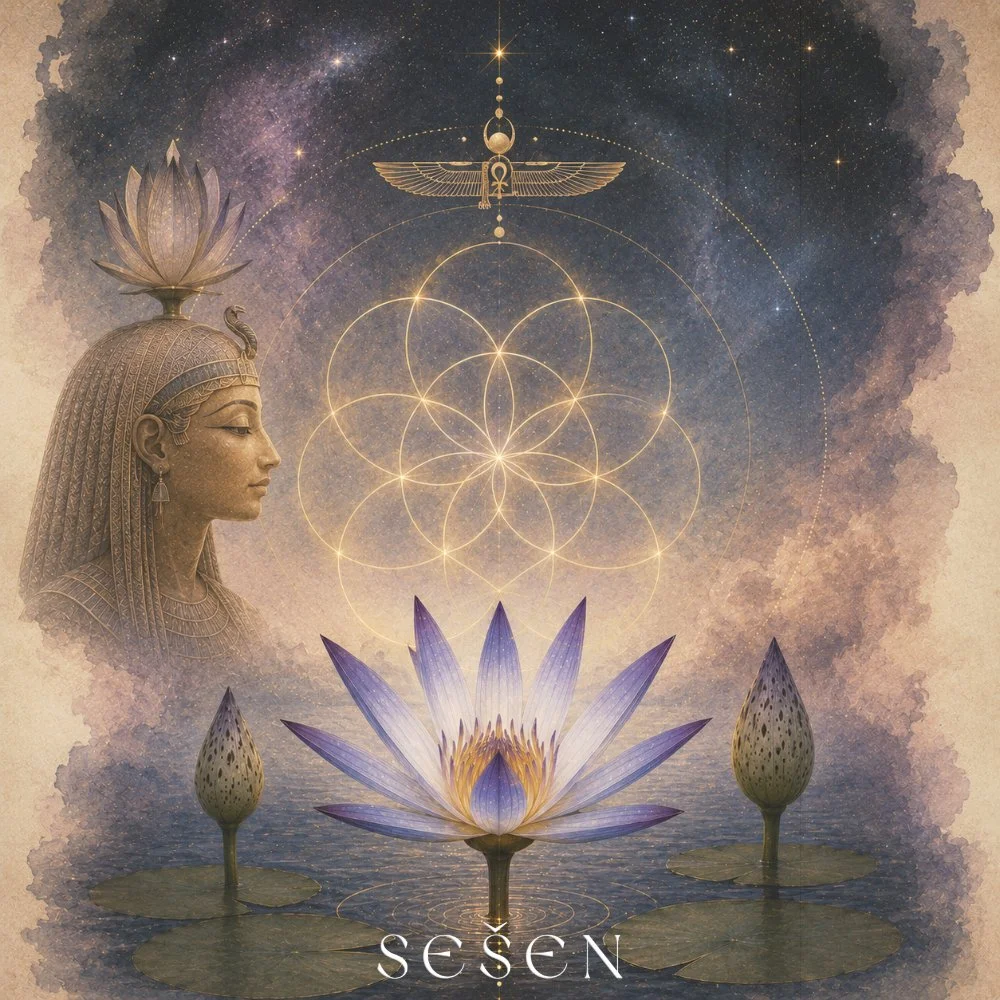
There are moments in history when it feels as though humanity is standing at a threshold.
The old ways no longer seem capable of carrying us forward, yet the new world has not fully arrived. We can feel it in our communities, in our relationship with the Earth, in the rapid acceleration of technology, and in the growing longing for a more beautiful, harmonious way of being.
Many people are searching for answers.
Yet perhaps the wisdom we need has been quietly surrounding us all along.
Nature has already solved many of the challenges we are attempting to navigate.
For billions of years, life has adapted to change without losing its relationship to the whole. Forests know how to regenerate. Rivers know how to find their course. Ecosystems know how to maintain balance through diversity, reciprocity, and cooperation.
Life evolves not through separation, but through relationship.
The Ancient Egyptians understood this principle deeply.
They called it Maat.
Maat is often translated as truth, balance, harmony, or right order. Yet it is perhaps better understood as living in accordance with the intelligence that already exists within creation.
The stars move according to Maat.
The seasons move according to Maat.
The river flows according to Maat.
Life flourishes when it exists in right relationship with itself.
This understanding was not unique to Egypt. Across the world, Indigenous traditions carried similar wisdom. Among the Nahua peoples of Mesoamerica, harmony emerged through reciprocity with the living world. Human beings were not separate from nature, nor masters of it. They were participants within a larger web of relationships.
Different cultures. Different languages. The same remembering.
Today, however, many of us have become disconnected from these rhythms.
One of the great challenges of the modern world is that we have forgotten how to experience time as nature experiences it.
The calendar moves in circles.
Monday becomes Monday.
January becomes January.
One year becomes the next.
Yet life does not move in circles.
Life moves in spirals.
The river returns to the shore, but as different water.
The tree flowers each spring, yet no spring is identical to the last.
The lotus blooms again and again, yet each opening carries the memory of every season that came before it.
Nature teaches us that evolution is not repetition.
It is remembrance expressed at a higher octave.
Perhaps this is why so many people feel a threshold approaching.
Not because the world is ending.
Because a cycle is completing.
And another is beginning.
In music, the eighth note returns to the first, yet on a higher octave.
The same note.
A new expression.
As we move toward Lion's Gate and the symbolism of 8/8, this feels particularly relevant.
Perhaps humanity is not being asked to become something entirely different.
Perhaps we are being invited to become a more integrated expression of what we already are.
To raise an octave.
To mature.
To remember.
No symbol captures this more beautifully than the lotus.
For thousands of years, the Blue Lotus was revered throughout Ancient Egypt as a symbol of creation, renewal, awakening, and the emergence of consciousness from the primordial waters. It appears throughout temple walls, sacred art, ritual vessels, and cosmological stories. To the Egyptians, the lotus was far more than a flower. It was a teacher.
And Egypt was not alone.
Across India, throughout Buddhist traditions, and among countless cultures separated by oceans and centuries, the lotus emerged as a symbol of spiritual evolution, resilience, and transformation.
Perhaps because it embodies one of the most important lessons life has to offer.
The lotus does not escape the mud.
It transforms it.
Its roots descend into darkness.
Its stem rises through water.
Its blossom opens toward the light.
Earth.
Water.
Sky.
The entire human journey contained within a single living form.
What makes this even more extraordinary is that the water lily family, from which the Egyptian Blue Lotus emerges, belongs to one of the oldest lineages of flowering plants on Earth. Long before human civilizations, before temples, before written language, these flowers were already opening and closing with the rhythm of the Sun.
For over one hundred million years, they have endured through immense planetary change.
Climate shifts.
Extinction events.
The rise and fall of ecosystems.
The reshaping of continents.
The lotus lineage has witnessed it all.
Perhaps this is why it feels less like a flower and more like an elder.
One of Earth's oldest teachers.
And its teachings are not merely symbolic.
The lotus helps purify the waters in which it grows. Water lilies contribute to healthy aquatic ecosystems, creating habitat, supporting biodiversity, regulating temperature, and helping maintain ecological balance.
The flower's wisdom is embodied in its function.
It does not simply rise above its environment.
It helps heal it.
There is a profound lesson in this for our time.
Many people speak about the future as though it exists somewhere beyond the horizon. A destination we are waiting to arrive.
Yet perhaps the future emerges the same way the lotus does.
Through relationship.
Through stewardship.
Through devotion to the conditions that allow life to flourish.
Around the world, people are being called toward sanctuaries, regenerative lands, healing spaces, food forests, temples, and new forms of community. Beneath these visions lies a common longing: to live once again in right relationship with Earth, with one another, and with the greater intelligence moving through creation.
This may be why so many are returning to the wisdom of water.
To the stars.
To ceremony.
To the land.
To the ancient teachings that remind us how to listen.
The future cannot be built from the same consciousness that created the imbalance we now seek to heal.
The blueprint must first become embodied.
A sanctuary begins before the land is shaped by hand.
A temple begins before the first stone is placed.
A new world begins before it becomes visible.
It begins within the vessel that carries it.
Perhaps this is the invitation of the threshold we find ourselves crossing.
To become more like the lotus.
To root ourselves in the Earth.
To remain open to the guidance of the stars.
To live in accordance with Maat.
To participate in the healing of the waters around us.
To remember that nature is not separate from spirit. The Ancient Egyptians understood this through the Neteru—the living principles expressed through the forces of creation. The Earth, the waters, the heavens, the winds, the cycles of life. All were teachers.
Perhaps nature itself is one of the oldest temples.
And perhaps the wisdom we seek has never left.
The lotus has been carrying it for over one hundred million years.
Patiently waiting for us to remember.
𓆸