THE SOLSTICE: ENTERING A NEW SOLAR CYCLE
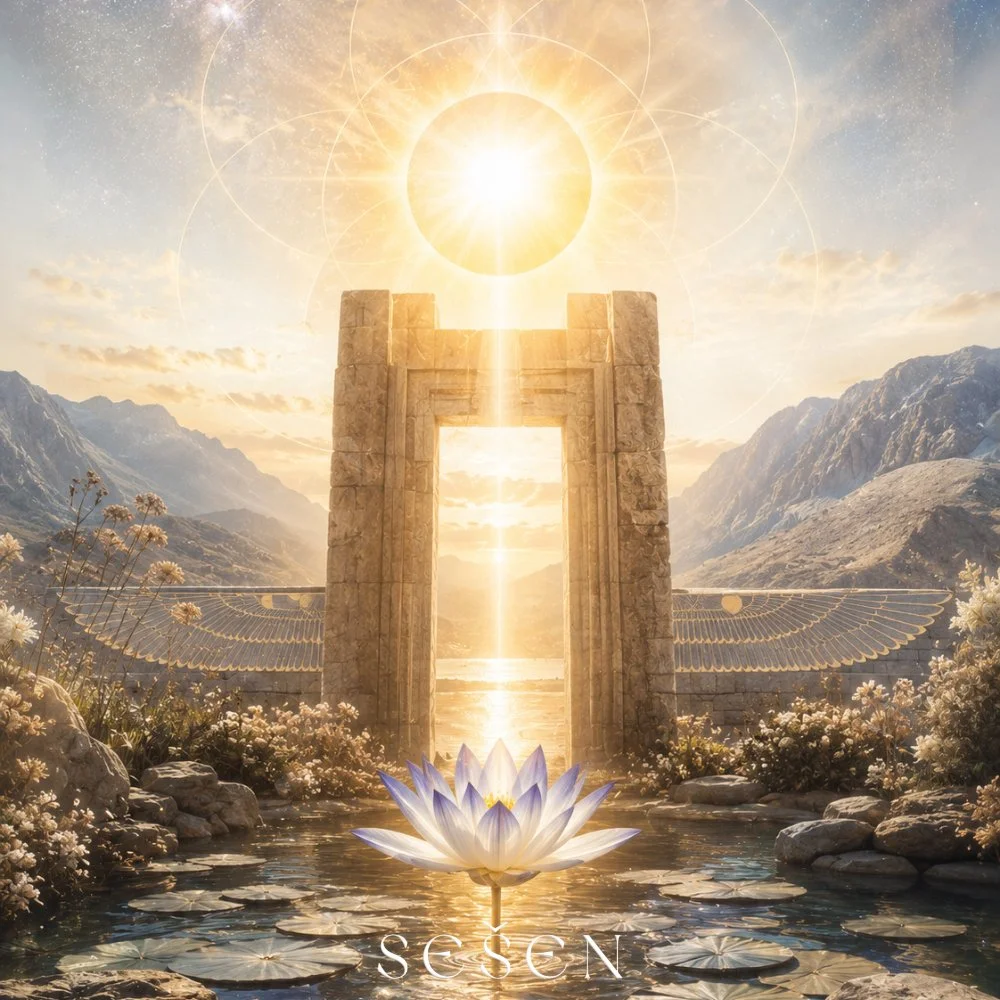
The solstice is not only a date in time.
It is a threshold in consciousness.
It marks the moment the Sun appears to pause at the edge of its highest or lowest arc, before silently turning toward its next becoming. This still-point has been honored across civilizations as a gateway — where time softens, and something deeper than time becomes visible.
In the Nile Valley of Kemet, this mystery was not abstract. It was lived through the living intelligence of the solar deities.
At dawn, the scarab form of Khepri was understood as the Sun being reborn — rolling itself across the horizon like a sacred act of self-creation. At midday, Ra ruled the full radiance of life. At sunset, Atum carried the Sun back into the unseen.
The Sun was never one fixed thing.
It was a cycle of becoming.
Temples across Kemet were oriented so that light would enter sanctuaries at precise solar alignments, turning architecture into a receiver of celestial intelligence — a technology of attunement between human consciousness and cosmic rhythm.
This same relationship between light, land, and ceremony is echoed across the Earth.
In the Andes, solar temples were aligned to solstice gates in the mountains. In Mesoamerica, pyramids tracked the Sun’s descent and return with precision. In ancient stone circles across the northern landscapes, sunrise and sunset at the turning points still pass through ancient alignments.
And what is most striking is this:
They still function.
The Sun still enters the same corridors.
The stones still receive the light.
The Earth still remembers.
Here in Ometepe, formed by twin volcanoes rising from the great lake, this same intelligence is felt in a different language — fire, water, stone, breath. The island itself becomes a living axis between worlds, where solar and volcanic forces meet.
There is something quietly radical in this continuity.
It suggests that beneath modern systems of timekeeping, there is an older intelligence still moving through everything — the rhythm of Earth and Sun, breath and body, cycle within cycle.
The solstice is a reminder that we are not outside nature observing it. We are nature remembering itself through form.
And yet this return is never repetition.
The Maya understood time as a spiral — recursive, alive, and evolving. We return to the same gates, but never as the same being. Each cycle refines perception. Each return deepens embodiment. Each turning carries both memory and renewal.
This is why the solstice feels both ancient and immediate.
It is not behind us. It is happening now.
Across this threshold, the solar field is also shifting in the wider sky — shaping inner and outer tides of change, reorientation, and re-alignment. But beyond interpretation, what matters most is what is directly felt:
something is turning.
We are not simply closing a chapter.
We are learning a new language of time.
Perhaps this is why solstice rituals persist across continents and centuries. They are not symbolic gestures. They are acts of alignment — moments where human awareness pauses long enough to remember its place within a greater intelligence.
As we cross this threshold, the invitation is simple:
What has completed its cycle?
What is ready to dissolve without resistance?
What is quietly forming that I have not yet named?
Whether you are moving into the longest night or the longest day, the teaching remains the same:
Pause.
Not as withdrawal, but as presence.
Listen.
Not for answers, but for resonance.
Align.
Not with urgency, but with truth.
And step — consciously, gently — into the next turning of the spiral.